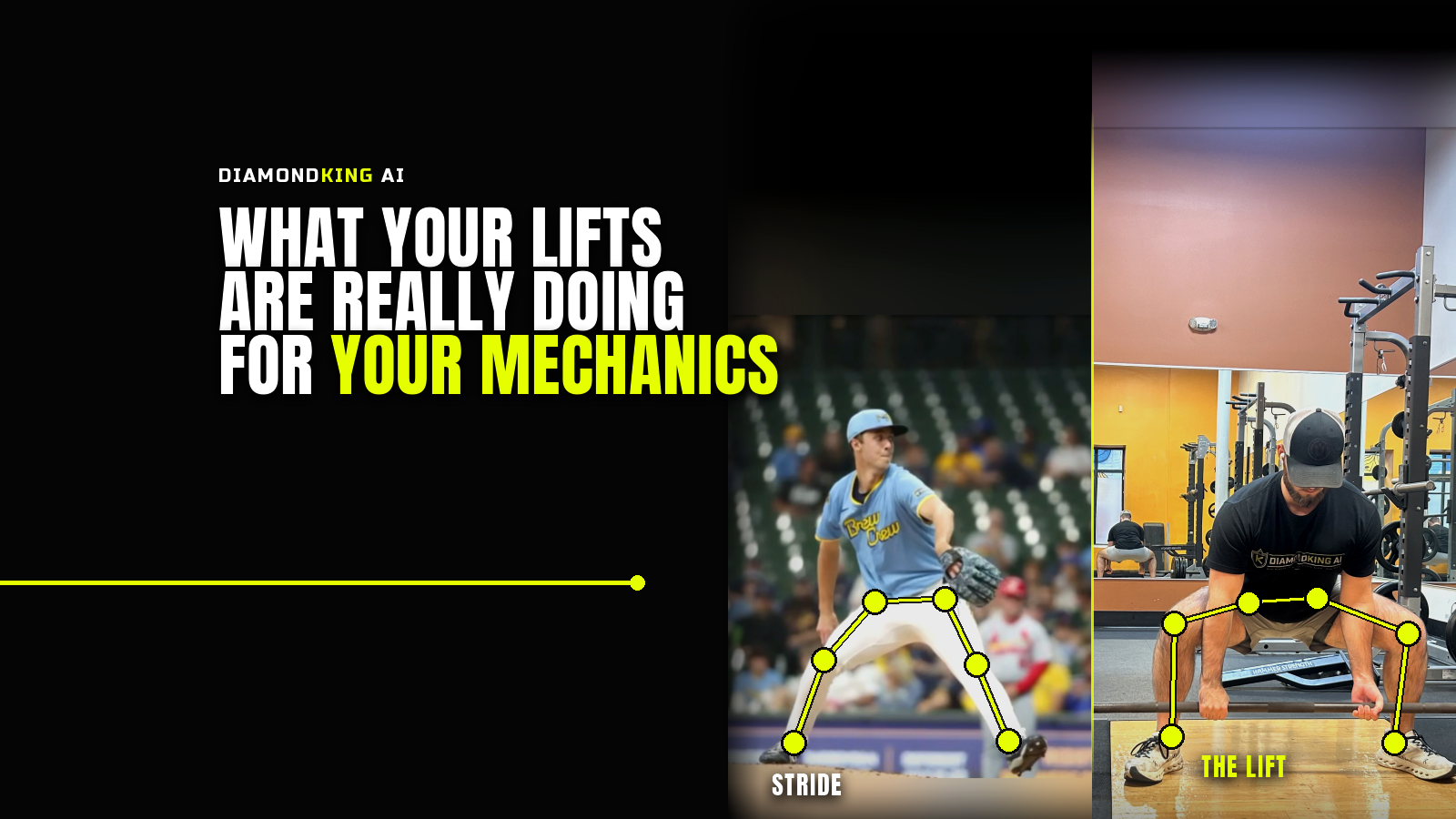
What Your Lifts Are Really Doing for Your Mechanics
Preston Piranio
November 25, 2026
Training
A lot of athletes are about to put in a whole winter in the weight room. The numbers will go up. The squat will go up. They'll look different in the mirror. And for a lot of players, spring will show up with the swing or the delivery looking exactly the same.
If you're the athlete, that's a frustrating way to start a season after doing the work. If you're the parent, you're paying for the gym and the lessons, and it can feel like the two don't connect.
Here's the part that doesn't meet the eye. Lifting does carry over to the field, but not automatically, and not always where you'd expect. Where it shows up depends a lot on which positions you get strong in, and on whether your body learns to use that strength once it's there.
I'm Preston Piranio, founder of DiamondKing AI. I pitched in college. This is for baseball players 13 and up, and for the parents in their corner.
Not medical advice. Educational content only, not a diagnosis, treatment plan, or clearance to train. For pain, injury, or starting a strength program, talk with a qualified clinician and check with your pediatrician.
Getting stronger is step one. Using it is step two.
An older study explains this well. Researchers built a computer model of a person doing a jump. They made the model's leg muscles stronger but kept the same timing the muscles fired with before. The stronger model jumped lower. Only after the timing was re-tuned for the new muscles did it jump higher than the original. The authors' takeaway was that strength work should come with exercises that let athletes "practice with their changed muscles."[1]
It's a simulation, not a team of ballplayers. But the idea carries over: a stronger body running the old pattern doesn't automatically move better. A review on strength transfer says the same thing in coaching terms: how the muscles coordinate together "is an important component in achieving transfer" to sport skills.[2]
The best baseball example I've found is a 12-week study of 49 high school players, average age about 15. Both groups did the same lifting program and took 100 swings a day, three days a week. One group also did rotational and full-body medicine ball work. Both groups gained about the same on the squat and bench. But only the med ball group got measurably faster at turning the hips (about 6.8%) and shoulders (about 8.8%) in the swing, and they gained more bat speed at the end of the bat (6.4% vs. 3.6%).[3]
Same strength gains. Different swing. What changed wasn't how strong they were. It was what that strength had been trained to do.
Where strength actually shows up
The back hip: loading and holding
For pitchers, a lot of the delivery happens on the back leg. You have to load that hip and hold it as you move down the mound, instead of just falling toward home. For hitters, it's staying loaded instead of drifting out early.
That back leg isn't just pushing straight ahead. In 30 college pitchers, the harder throwers made more force through the back hip, including the muscles that hold the hip and turn it, and more force through the back knee.[4] In 22 college hitters, most of what turned the body came from both legs pushing sideways into the ground, with the hips and front knee doing the most work.[5]
That's why I like single-leg squats and wide-stance (sumo) deadlifts for this. Hitting and throwing both happen on one leg at a time, and a hitter's wide stance or a pitcher at the top of the leg lift isn't that far off from a wide-stance pull.
The front side: taking the hit
Then the front leg lands, and everything has to stop and turn around it. In a classic hitting study, as the hitter strode forward, the front foot pushed into the ground with force equal to about 123% of his body weight, helping the body accelerate around the trunk. The hips hit their top speed before the shoulders did.[6] Pitchers have their own version: in a study of high school and pro pitchers, the ones whose front knee straightened more after landing threw harder. In the high schoolers, it also came with more elbow stress, so it isn't a simple "more is better" number.[7]
Here's the catch, and it's one I care about. A soft front leg is usually a symptom, not the problem. When the hips flip, the back hip comes through and takes the front hip's spot, and the knee straightens as a byproduct of that rotation. So no lift "fixes" a block by itself. What the lifts do is give that leg the strength to take the force when it shows up. For that I like front lunges, split-stance squats, walking lunges, and pretty much any single-leg work, like single-leg RDLs.
Rotation: a path, not just an engine
People hear "core" and think crunches. But in a study of 98 amateur players hitting tossed balls, the torso didn't create most of the energy in the swing. It acted as "a pathway for the transfer" of energy from the hips to the arms and bat.[8] Your trunk's job is to pass the turn along without leaking it.
Rotational power shows up in a way straight-ahead power doesn't. In 35 college players, rotational med ball throw speed lined up with bat speed and with pitching velocity. A broad jump and a side-to-side jump didn't line up with either.[9] That's one small group and a correlation, not proof. But it fits the high school study above.
For hitters, I like rotational cable work, but my favorite is med ball tosses that look like the swing, like a scoop toss, or a toss where the upper half pushes the ball. For pitchers, the same idea applies: med ball throws done the way you actually move on the mound.
Single-leg control
This one's easy to miss. In 347 pro pitchers, the ones whose pelvis wobbled the most during a simple single-leg raise test in spring training were about three times as likely to miss 30 or more days that season as the ones who wobbled least.[10] That's pro pitchers and an association, but it shows single-leg control isn't a finisher at the end of a workout. It's part of the job.
What doesn't meet the eye
Sometimes a mechanical flaw has a strength cause underneath it. Leaning way over to the glove side at release is a good example. In high school pitchers, that lean went with higher ball speed, but also with more stress on the shoulder and elbow.[11] In a group of 28 youth pitchers, the ones who leaned the most showed an imbalance in their trunk rotation strength between sides.[12] You can cue a kid to "stay tall" all season, and if the trunk can't hold him there, he'll find the lean again.
Strength also isn't the same thing as using it. In 52 high school pitchers, push-off force from the back leg was only weakly tied to ball speed, weaker than what's been reported in adults. The authors suggested that training high schoolers to "better use body momentum" may help.[13] In 19 college pitchers, jump power lined up with fastball velocity, but pelvis and trunk mechanics didn't line up with any of the jump numbers.[14] Strong legs and good hip and trunk movement are related, but they're not the same thing.
Turning strength into something you can use
So how does the gym get to the field? The way I see it, three things have to line up:
Mobility first, when the position needs it. If you can't get into the position, loading it just makes you stronger at the wrong pattern. At DiamondKing, the mobility intake answers that question. If the mobility tests that affect a position look bad, that's likely where we start. If they look clean, it's just learning to feel the position.
Strength in the positions the sport uses. Single-leg, wide and deep hips, and rotation, not just straight up and down.
A bridge back to the movement. Med ball tosses done just like a swing or a pitch. Jumps to build explosiveness, which helps turn strength into power. Then you still have to train the skill on the field.
Preston's take: learning to use my back leg
Personal experience, not science, and not a promise for anyone else.
There was no one exact moment. But when I really started learning how to use my back leg, two of the lifts I was doing were single-leg squats and wide-stance sumo deadlifts.
Young athletes shouldn't lift alone. Have a qualified adult supervise, and check with your pediatrician.
For the athlete: lift for the field, not the photo
Ego lifting isn't what gets attention on the baseball field. In fact, it can often lead to injuries, since you're trying to move a lot of weight with the wrong form. If we can't control the weight in the right positions, it does us no good.
The number on the bar matters. Being able to own the position matters more.
For parents: where the gap usually hides
If your kid is lifting hard and the field isn't changing, it usually isn't effort. Ask a few simple questions. Are the lifts in the positions his sport uses, or mostly straight up and down? Is anyone checking whether he can get into those positions before loading them? Is there anything connecting the gym back to the swing or the delivery, or are they two separate worlds?
Where DiamondKing fits
This is why I don't think the weight room and the field should be planned separately. At DiamondKing, your Performance Team builds one plan around the whole athlete. It starts with the mobility intake, and the lifts stay the same across each 4-week block with progressive overload, so the body has time to own them. The point is for the strength side and the mechanics side to work toward the same thing. DiamondKing programs also include med ball and jump work, the bridge that helps carry that strength into the swing or the delivery. For hitters, that plan is about the swing. For pitchers, it's the delivery. Either way, it's one athlete and one plan.
---
Sources
[1] Bobbert, M.F., & Van Soest, A.J. (1994). Effects of muscle strengthening on vertical jump height: a simulation study. Medicine and Science in Sports and Exercise, 26(8), 1012–1020. https://pubmed.ncbi.nlm.nih.gov/7968418/
[2] Young, W.B. (2006). Transfer of strength and power training to sports performance. International Journal of Sports Physiology and Performance, 1(2), 74–83. https://pubmed.ncbi.nlm.nih.gov/19114741/
[3] Szymanski, D.J., McIntyre, J.S., Szymanski, J.M., Bradford, T.J., Schade, R.L., Madsen, N.H., & Pascoe, D.D. (2007). Effect of torso rotational strength on angular hip, angular shoulder, and linear bat velocities of high school baseball players. Journal of Strength and Conditioning Research, 21(4), 1117–1125. https://pubmed.ncbi.nlm.nih.gov/18076221/
[4] Kageyama, M., Sugiyama, T., Takai, Y., Kanehisa, H., & Maeda, A. (2014). Kinematic and kinetic profiles of trunk and lower limbs during baseball pitching in collegiate pitchers. Journal of Sports Science & Medicine, 13(4), 742–750. https://pubmed.ncbi.nlm.nih.gov/25435765/
[5] Ae, K., Koike, S., Fujii, N., Ae, M., & Kawamura, T. (2017). Kinetic analysis of the lower limbs in baseball tee batting. Sports Biomechanics, 16(3), 283–296. https://pubmed.ncbi.nlm.nih.gov/28632063/
[6] Welch, C.M., Banks, S.A., Cook, F.F., & Draovitch, P. (1995). Hitting a baseball: a biomechanical description. Journal of Orthopaedic & Sports Physical Therapy, 22(5), 193–201. https://pubmed.ncbi.nlm.nih.gov/8580946/
[7] Dowling, B., Hodakowski, A., Brusalis, C.M., Luera, M.J., Smith, C.D., Verma, N.N., & Garrigues, G.E. (2024). Influence of lead knee extension on ball velocity and elbow varus torque in professional and high school baseball pitchers. Orthopaedic Journal of Sports Medicine, 12(8). https://pubmed.ncbi.nlm.nih.gov/39157018/
[8] Horiuchi, G., Nakashima, H., & Sakurai, S. (2024). Mechanical energy flow in torso during baseball toss batting. Sports Biomechanics, 23(9), 1136–1146. https://pubmed.ncbi.nlm.nih.gov/34009088/
[9] Taniyama, D., Matsuno, J., Yoshida, K., Pyle, B., & Nyland, J. (2021). Rotational medicine ball throw velocity relates to NCAA Division III college baseball player bat swing, batted baseball, and pitching velocity. Journal of Strength and Conditioning Research, 35(12), 3414–3419. https://pubmed.ncbi.nlm.nih.gov/34570055/
[10] Chaudhari, A.M., McKenzie, C.S., Pan, X., & Oñate, J.A. (2014). Lumbopelvic control and days missed because of injury in professional baseball pitchers. American Journal of Sports Medicine, 42(11), 2734–2740. https://pubmed.ncbi.nlm.nih.gov/25159541/
[11] Oyama, S., Yu, B., Blackburn, J.T., Padua, D.A., Li, L., & Myers, J.B. (2013). Effect of excessive contralateral trunk tilt on pitching biomechanics and performance in high school baseball pitchers. American Journal of Sports Medicine, 41(10), 2430–2438. https://pubmed.ncbi.nlm.nih.gov/23884305/
[12] Oyama, S., Waldhelm, A.G., Sosa, A.R., Patel, R.R., & Kalinowski, D.L. (2017). Trunk muscle function deficit in youth baseball pitchers with excessive contralateral trunk tilt during pitching. Clinical Journal of Sport Medicine, 27(5), 475–480. https://pubmed.ncbi.nlm.nih.gov/27753641/
[13] Oyama, S., & Myers, J.B. (2018). The relationship between the push off ground reaction force and ball speed in high school baseball pitchers. Journal of Strength and Conditioning Research, 32(5), 1324–1328. https://pubmed.ncbi.nlm.nih.gov/28486333/
[14] Sakurai, M., Qiao, M., Szymanski, D.J., & Crotin, R.L. (2024). Countermovement jump and momentum generation associations to fastball velocity performance among Division I collegiate pitchers. Journal of Strength and Conditioning Research, 38(7), 1288–1294. https://pubmed.ncbi.nlm.nih.gov/38900174/